BAAQ NABADEED OO KA YIMID HAWEENKASOOMAALIYEED




To: Leadership of the House of the People of the Federal Republic of Somalia.
Cc: Leadership of the House of Senate of the Federal Republic of Somalia
Honorable Leaders, Somali Gender Equity Movement (SGEM) is an organization advocating for the political, social, and economic rights and representation of Somali women. We also work on civic education, peace, security, and reconciliation in Somali society, emphasizing the role women should play. We, the Board of Directors and members of SGEM, consisting of nearly 8,000 Somali women committed to protecting women’s rights, strongly condemn, oppose and are very saddened by the decision to give the seat resigned by Hon. Sahra Colaad to a man.
Honorable Leaders, the women MPs in both houses secured their seats due to the women’s quota of a minimum 30%, established in all political and electoral agreements since 2012 and approved by the parliament. Although the goal of achieving a minimum 30% women quota has not yet been realized, significant efforts have been made by Somali women and civil society in general to accelerate this progress.
Honorable Leaders, we have serious concerns regarding the legal process and the speed with which Hon. Sahra Colaad’s vacated seat was filled. By law, when a Federal Parliament seat is being filled, the National Assembly passes a law and appoints a committee to oversee the process. This task was previously handled by the now-disbanded National Independent Electoral Commission. Therefore, how did the President of Galmudug approve a seat not elected by a constitutional commission/committee, and how did the parliament swear him in? Secondly, with up to five seats in the House of the People remaining vacant for some time, why was the recently vacated seat filled so quickly in the Galmudug Federal Member State?
Honorable Leaders, we are also concerned about the declining number of women MPs in the House of the People, which has decreased from 67 (24%) in the 10th Parliament to 52 (19%) in the 11th Parliament, with one seat still vacant after the death of MP Khadija Mohamed Diriye (May Allah grant her mercy) in December 2023. We fear that just as her Minister position was given to a man, her parliamentary seat may also be offered to a man.
Honorable Leaders, as the legislative body of the country, we urge you to uphold and not undermine the minimum 30% quota for women’s seats in parliament. A seat vacated by a woman should be filled by another woman from her subclan. Somali women, who comprise 50% of the population, must have their rights to political representation protected.
Muqdisho
Ku: Gudoonka Golaha Shacabka Jamhuuriyada Federaalka Soomaaliya
Og: Gudoonka Aqalka Saree ee Jamhuuriyada Federaalka Soomaaliya
Mudanayaal iyo Mudan, Somali Gender Equity Movement (SGEM) waa hey’ad u oleleysa haweenka Soomaaliyeed in ay helaan xuquuqdooda iyo metelaad siyaasadeed oo u qalanta, mid bulsho, iyo dhaqan- dhaqaale. Waxaa kale oo ay ka shaqeysa baraarujinta iyo wacyigelinta nabadda, amniga iyo dhab-u-heshiinta ummadda Soomaaliyeed iyo sidii ay haweenku uga qaadan lahaayeen doorkooda. Innaga oo ah Guddiga Sare iyo xubnaha SGEM oo ka kooban ku dhawaad 8,000 oo ah haween Soomaaliyeed oo mar kasta u taagan ilaalinta xuquuda haweenka, waxaan cambaareyneynaa, ka soo horjeednaa, aadna uga xunnahay kursigii Xildhibaanad Sahra Colaad ay iska casishay in la siiyo nin.
Mudanayaal iyo Mudan, haweenka xildhibaanada labada aqal waxay ku fadhiyaan qoondada haweenka ee ugu yaraan 30% oo ku jirtay dhamaan xeerarkii heshiiyada doorashooyinka ilaa 2012 oo baarlamaanku ansixiyey. Inkastoo aan wali la gaarin hiigsiga qoondada haweenka ee ugu yaraan 30%, hadana waxaa laga soo maray dadaal fara badan oo ay ku bixiyeen haweenka Soomaaliyeed iyo bulshada rayidka guud ahaan.
Mudanayaal iyo Marwo, waxaa su’aalo waaweyn ka taagan yihiin hab sharciyeedka loo maray iyo deg-dega loo buuxiyey kurigii ay iska casishay mudan Sahra Colaad. Sharciyan, marka kursi xildhibaan federaal la buuxinayo, Golaha Shacbka ayaa xeer ka soo saara oo magacaaba guddi ka soo shaqeeyo buuxinta kursiga. Markii hore waxaa loo idman jiray Guddiga Madaxa Bannaan ee Doorashooyinka Qaran ee la kala diray. Sidaas daraadeed, kursi uusan doorashadiisa qaban guddi sharci ku taagan sidee Madaxweynaha Galmudug u oggolaaday, sideese baarlamaanku u dhaariyey? Tan labaad, iyada oo ay bannaan yihiin ilaa iyo 5 kursi oo Golaha Shacabka ah, maxaa kii ugu dambeeyey si deg deg ah loogu qabtay doorashadiisa dowlad-goboleedka Gamudug?
Mudanyaal iyo Mudan, waxaan kale oo aan walwal ka qabnaa kuraasta haweenka xildhibaanada oo sii yaraanayo maadaama tirada xildhibaanada haweenka Golaha Shacabka ahaayeen Baarlammankii 10-aad 67 (24%) laakiin ay hoos u dhacday Baarlamaanka 11-aad oo ay waqtigan xaadirka ah yihiin 52 (19%), iyo hal kursi oo aan wali la buuxin kadib markii ay geeriyootay xildhibaanad Khadiija Maxamed Diiriye (Allah naxariistii Janno ha siiyee) bishii Diseembar 2023 oo aan walwal ka qabnaa sida jagadeedii wasiirnimo nin loogu beddelay in kursigeedii xildhibaannimadana nin la siiyo.
Mudanayaal iyo Mudan, maadaama Baarlamaanku yahay hay’adda sharci-dejinta dalka, waxaan idinku boorineynaa in la dhowro oo aan lagu takrifalin qoondada haweenka ee ugu yaraan 30% oo kuri baarlamaanka ee haweeney ku fadhiday uu banaanada in lagu beddelo haweeney jifadeeda ah. Haweenka Soomaaliyeed oo ah bulshada barkeed (50%), waa in la dhowro metelaaddooda siyaasadeed.
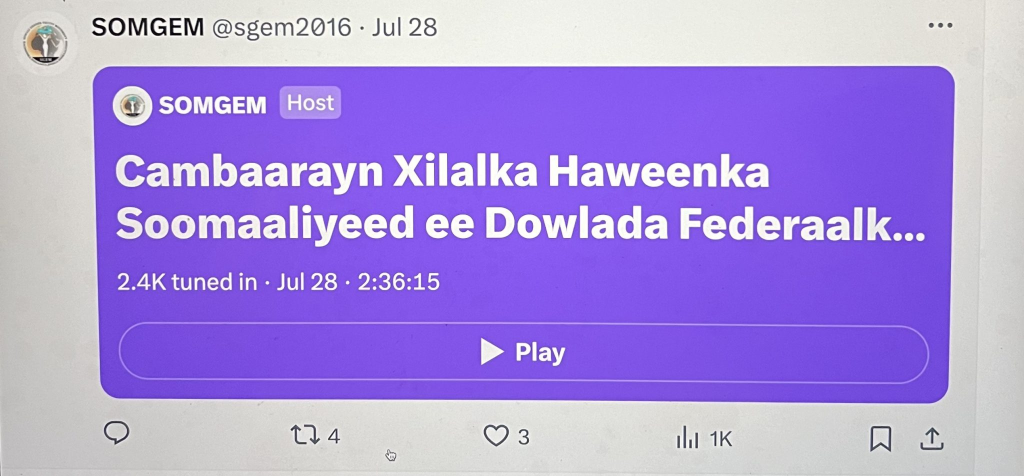
In follow-up to the “Call for Condemnation of Somali Women Federal Government Positions Being Appointed to Men,” addressed to the Prime Minister of the Federal Republic of Somalia, Hon. Hamze Abdi Barre, and copied to Hon. Hassan Sheikh Mohamud, the President of the Federal Republic of Somalia, SGEM held a forum on X Spaces to discuss these issues. The forum was attended by Members of Parliament, politicians, technocrats, women’s rights advocates, and other civil society members including SGEM members.
The aim of the forum was to address the decreasing number of females in the federal government, including the Cabinet of Ministers, which is composed of 75 members. Only 9 (12%) were women, and on July 27, 2023, women lost one minister and one state minister, reducing their representation to 7 (9%). The forum expressed strong condemnation, opposition, and deep sadness over the renaming of the Ministry of Women and Human Rights Development to the Ministry of Family and Human Rights Development and its appointment of a man, General Bashir Mohamed Jama (Bashir Goobe), as well as other key positions previously held by women being appointed to men.
The positions previously held by women and now appointed to men include:
SGEM’s Founder & Executive Director read the key points of the “Call for Condemnation of Somali Women Federal Government Positions Being Appointed to Men” to over 2,000 individuals who participated in this forum, which included key recommendations. Forum participants who spoke in the space also made important recommendations.
The key recommendations expressed include:
SGEM’s key recommendations from the “Call for Condemnation of Somali Women Federal Government Positions Being Appointed to Men” letter include:
SGEM thanked the co-moderators of the forum, Fatima Ibrahim (Malta) and Shamsa Shegow, and key speakers, including MP Mursal Khalif, MP Mohamed Ibrahim (Ma’alimu), Halima Ismail, former Chair of the National Independent Electoral Commission, all the other speakers and all the participants of the forum.
You can listen the whole forum discussion in this link:
To: Hamze Abdi Barre- Prime Minister of the Federal Republic of Somalia
Cc: President of the Federal Republic of Somalia
Hon Prime Minister, we, the Somali Gender Equity Movement (SGEM), together with our Board of Directors and nearly 8,000 dedicated Somali women members who are always committed to the protection and advancement of women’s rights, express our strong opposition, profound condemnation, and deep sorrow over the recent decision to rename the Ministry of Women and Human Rights Development (MoWHRD) to the Ministry of Family and Human Rights Development. Moreover, we are deeply concerned by the appointment of a male general as its new minister and the alarming trend of rapidly replacing women in federal government positions with men.
The original mandate of the MoWHRD was specifically designed to address the unique needs of Somali women, along with policies and legislation that directly impact them. By shifting its focus away from women’s issues, we fear this change undermines the progress that has been made in advancing gender equality in Somalia. It sends a troubling message about the diminishing importance of women’s voices in critical decision-making processes and risks marginalizing women’s issues further.
Hon Prime Minister, it is disheartening to note that the current Council of Ministers, consisting of 75 members, includes only 9 women (12%). With yesterday’s appointment, women lost one Minister and one State Minister position, reducing the female representation in the cabinet to 7 (9%). The positions previously held by Somali women that were given to men include:
Hon Prime Minister, it is also concerning that two women leaders were prevented from running for international positions, specifically for the Inter-Parliamentary Union President and AU Commission Chair roles.
With over 50% of our population being women, their exclusion from government structures hinders the development goals of Somalia. Our country cannot achieve its full potential without the knowledge, experience, talent, and intellect of Somali women.
We offer the following recommendations:
We urge all public institution heads to adhere to the agreement on women’s quotas, ensuring a minimum of 30% representation in political and all government institutions in all levels.
Muqdisho
Ku: Xamsa Cabdi Barre, Ra’iisul Wasaaraha Jamhuuriyada Federaalka Soomaaliya
Og: Madaxweynaha Jamhuuriyada Federaalka Soomaaliya
Mudane Ra’iisul Wasaare, annaga oo ah Dhaqdhaqaaqa Somali Gender Equity Movement oo loo soo gaabiyo SGEM, Guddiga Golaha Sare iyo xubnahiisa oo ku dhawaad 8,000 oo haween Soomaaliyeed oo mar kasta u taagan ilaalinta xuquuda haweenka waxaan ka soo horjeednaa, cambaareyneynaa, aadna uga xunnahay jagooyinka haweenka Soomaaliyeed oo markii horeba hooseeyey in qaar badan si xawli ah rag loogu beddelayo.
Mudane Ra’iisul Wasaare, waxaa nasiib darro ah in Golaha Wasiirada oo ka kooban 75 xubnood ay markii horeba 9 kaliya (12%) haween ahaayeen, maalintii shalayna ay haweenku lumiyeen hal wasiir iyo hal wasiiru dowle oo ay hadda hoos ugu dhaceen 7 (9%). Illaa iyo hadda jagooyinka ay ku fadhiyeen haween Soomaaliyeed oo rag la siiyey waxaa ka mid ah:
Mudane Ra’iisul Wasaare, waxaa kale oo jira in labo haween ah laga hor-istaagay in ay u tartamaan jagooyinka caalamiga ah ee Guddoomiyaha Ururka Midowga Afrika iyo Madaxwaynaha Baarlamaanka Adduunka.
Maadaama aan ogsoon-nahay in bulshadeenna in ka badan 50% ay haween yihiin, hadii la curyaamiyo waxaa hoos u dhacaya horumarka ay Soomaaliya hiigsaneyso. Dalkeennu ma gaari karo horumarka uu tiigsaneyso inta aqoonta, qibrada, kartida iyo fakarka haweenka Soomaaliyeed ka maqan tahay haykalka dawladnimo.
Waxaa soo jeedineynaa talooyinka soo socdo:
Waxaan ku boorineynaa dhamaan madaxda hay’adaha dawliga ah in ay dhowraan heshiiska qoondada haweenka ee ugu yaraan 30% ee metelaadda siyaasadda iyo haykallada dowladda ee haweenka.
Waxaan idin ka sugaynaa jawaab deg-deg ah indinka oo tixgelinaya codsigayaga
The federal institutions mandated by the constitution to draft and review the Provisional Constitution, namely the Constitutional Review, Implementation and Oversight Committee of the Federal Parliament of Somalia (OC) and the Independent Constitutional Review and Implementation Commission (ICRIC), began the review process of the first four chapters of the Provisional Constitution. The OC focuses on revising and amending the constitution, while the ICRIC handles the technical aspects. Against this backdrop, the Somali Gender Equity Movement (SGEM), in collaboration with women parliamentarians from both houses and civil society women, started advocating the amendment of Article 3, Paragraph 5 of Chapter One on the Basic Principles to clearly state: “Women shall hold a minimum of thirty percent (30%) of all positions across all three branches of government and independent commissions at Federal, Federal Member States, and local government levels, including elected and appointed positions” in the Provisional Constitution.
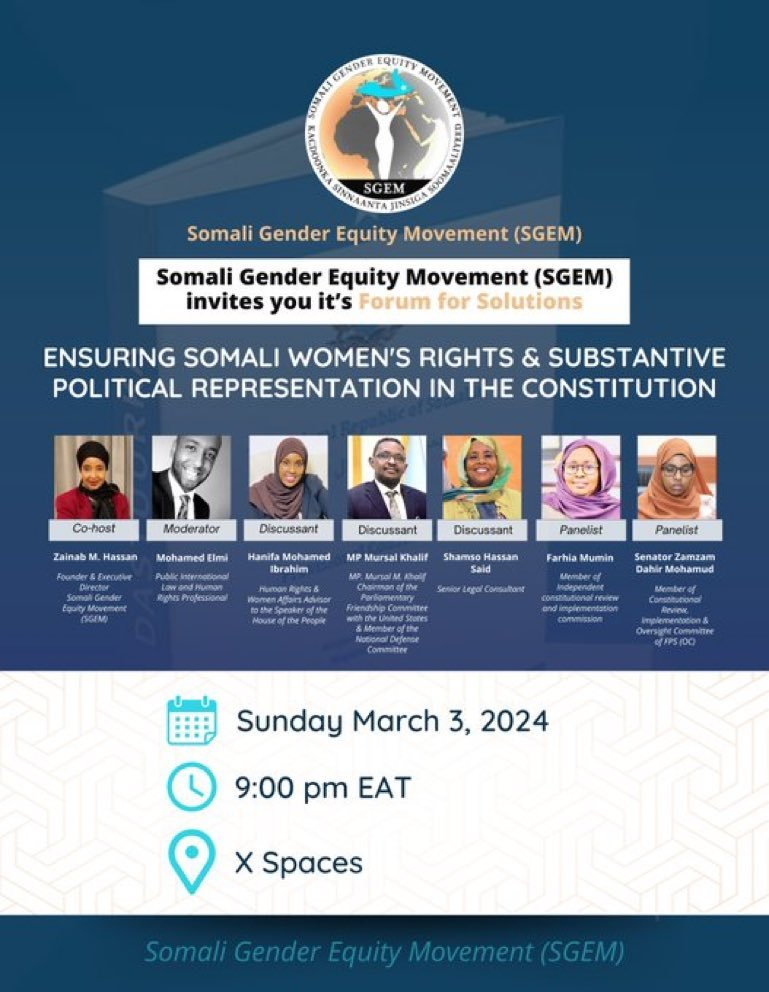
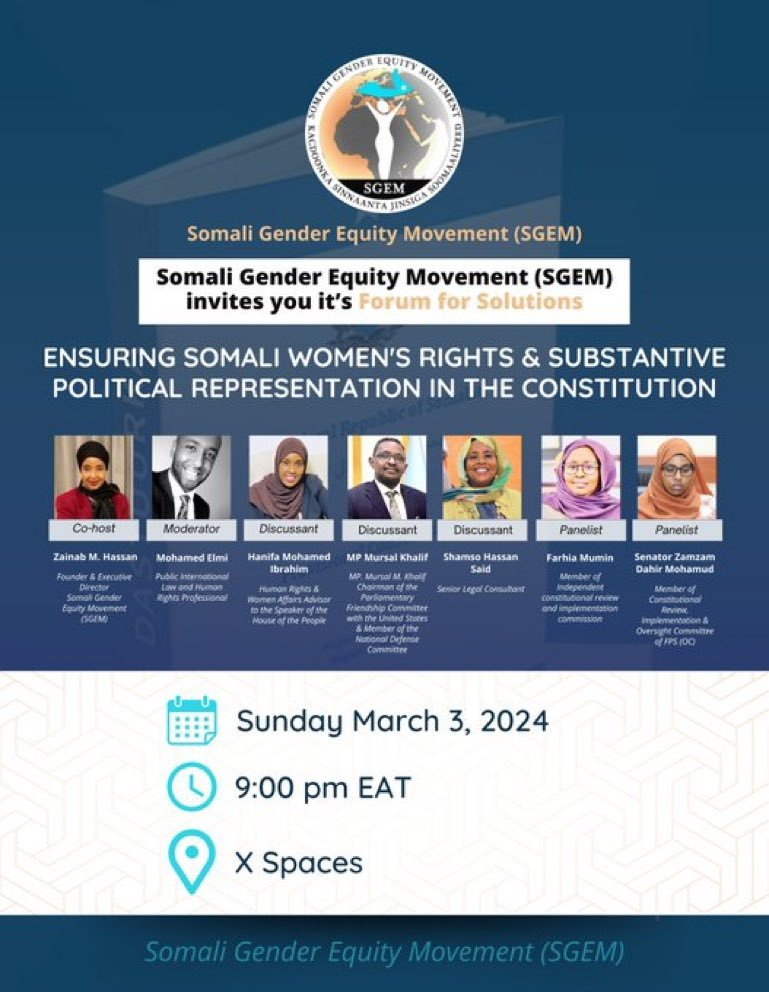
SGEM held its Forum for Solutions on this topic, entitled Ensuring Somali Women’s Rights & Substantive Political Representation in the Constitution, on March 3, 2024. SGEM invited esteemed panelists and discussants, including members directly involved in the Constitution review process and legal experts. These panelists and discussants were:
The forum was moderated by Mohamed Elmi, a Public International Law and Human Rights Professional, and co-hosted by Zainab M. Hassan, Founder & Executive Director of SGEM.
The panel discussed the mandate and role of their respective institutions in the ongoing constitutional review process, the basic rights of women citizenship, women’s substantive political representation, and the main challenges that have been impeding the formal inclusion of the women’s quota in the constitution. Additionally, the discussion highlighted the importance of building alliances and ensuring more male parliamentarians support women’s rights and the formal women’s quota in the constitution.
Panelists addressed whether the inclusion of the minimum 30% women’s quota in the constitution requires complementary laws, policies, or reforms to dismantle broader structural inequalities that impede women’s meaningful political participation in Somalia. They discussed how this can be enforced and implemented at the federal, member states, and local government levels. Conversely, they also explored alternatives to ensure women’s political representation if the quota is not formally included in the constitution.
The panelists highlighted the next steps once the ongoing constitutional review process is completed, and participated in a question and answer session with participants.
Panelists and discussants concluded with the importance to effect meaningful change by tailoring policies and initiatives according to the specific needs and contexts of communities. This involves identifying leaders within these communities who can effectively drive change. Establishing mentorship programs, starting from schools and extending to universities and beyond, which can help nurture a pipeline of qualified women professionals and leaders. Women who are already in leadership roles as valuable mentors and role models for girls in educational institutions, motivating them to engage politically. Panelists and discussants recognize implementing such initiatives requires collaboration between various stakeholders, including independent organizations, civil society groups, and government agencies. These partnerships should be driven by a shared interest in promoting gender equity and empowerment.
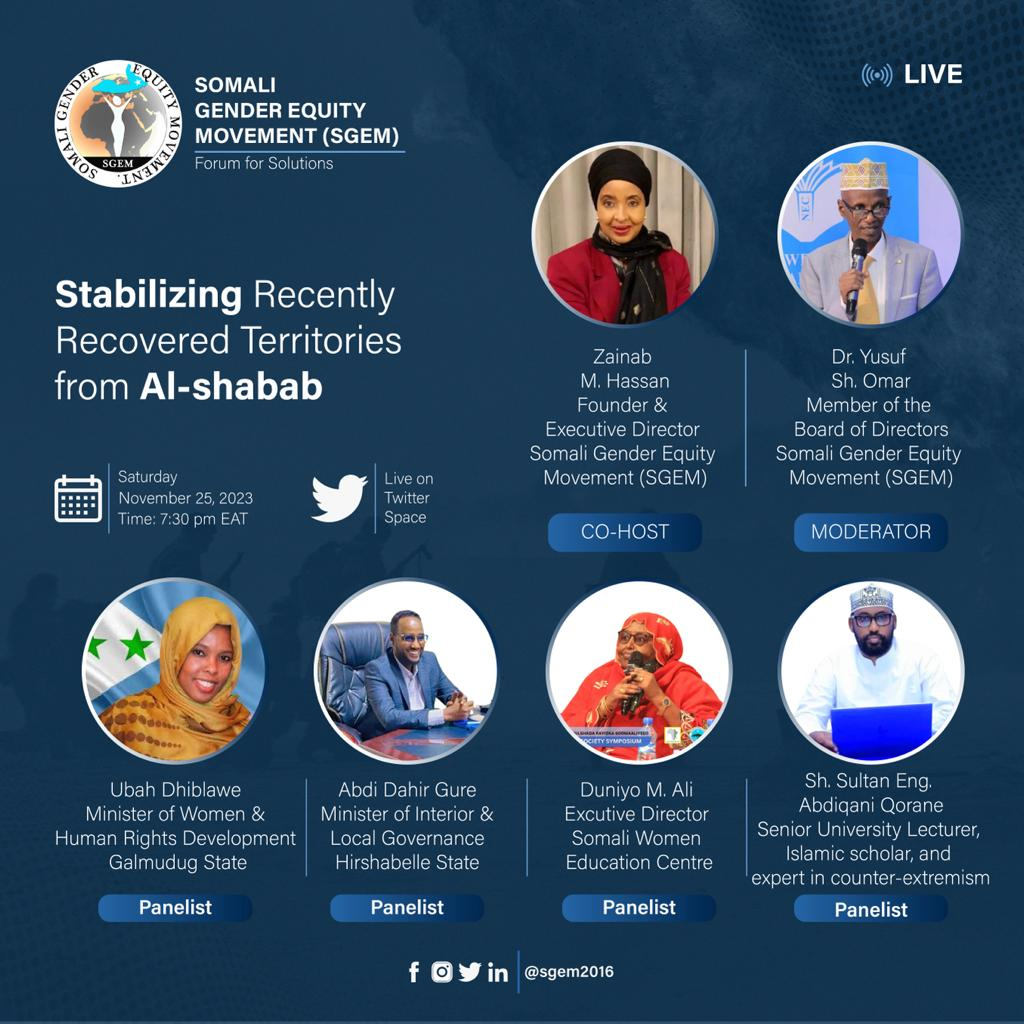
The Federal Government of Somalia (FGS) has been involved in an offense against al-Shabaab since August 2022. The offensive war against al-Shabaab started organically by community militias known as Ma’awisley who were fed up with al-Shabaab’s extorsion, terror attacks, killings and forcibly recruiting children and youth in their war. This is the first time that the Somali National Army (SNA), and local communities like Ma’awisley are fighting against al-Shabaab collectively coupled with United States and Turkey aerial drones.
SGEM has organized its Forum for Solutions on this topic, entitled ‘Stabilizing Recently Recovered Territories from al-Shabaab’ which was held on November 25, 2023. The panelists included regional leaders, religious scholar/traditional elder and topic experts including Abdi Dahir Gure, Minister of Interior and Local Governance for Hirshabelle Federal Member State; Ubah Dhiblawe, Minister of Women and Human Rights Development for Galmudug Federal Member State; Sultan Abdisalam Qorane, Senior University Lecturer, Islamic Scholar and Expert on Counter Terrorism; and Duniyo Mohamed Ali, Executive Director of Somali Women Education Centre.
The forum provided an informative discussion on the overall status of the offensive against al-Shabaab in the national and regional levels, its challenges, and the ongoing stabilizing efforts in the Federal Member States (FMSs). Leaders from theFMSs identified the role that their ministries are playing, the challenges that women and their families are facing, and the role women are playing in the overall efforts. Other panelists further highlighted the role that the civil society including women organizations and groups, traditional elder and religious leaders are playing in the offensive, and stabilizing the territories that are recently liberated from al-Shabaab.
Somali women play a significant role in supporting the offensive war against al-Shabaab. Women are members of the SNA and Ma’awisley militias, but most of their support comes as humanitarian, taking care of the injured, preparing and providing ration for the armed forces, fundraising from diaspora communities, providing encouragement and moral support, and conducting civic education for the citizens in the newly liberated areas.
Some of the key accomplishments highlighted include the liberation of 52,000 KM2 area from al-Shabaab including 126 districts, and villages in which 57 villages were operation centers created by al-Shabaab, and are currently in the hands of the government. Despite the significant progress make in the offensive against al-Shabaab, there are also some challenges including Somali National Army (SNA) stopping the fighting and restarting which gives al-Shabaab an opportunity to regroup and plan attacks against the SNA and the communities that are part of the offensive. In addition, the liberated areas face many challenges including lack of education and health care centers since some of these areas were under al-Shabaab control for the past 15 years. Lack of stabilization and development efforts for the newly liberated areas is another challenge. Women also face some specific challenges as they are excluded from the planning and stabilization efforts. This causes their views and specific needs are missing from the planning process, and as a result from the implementation of projects and services.
Some of the key recommendations are:
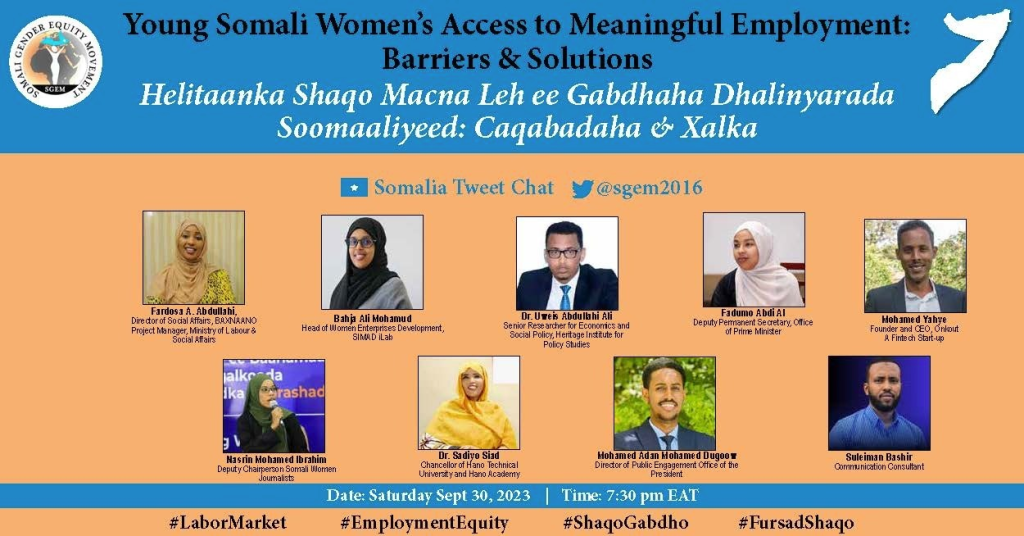
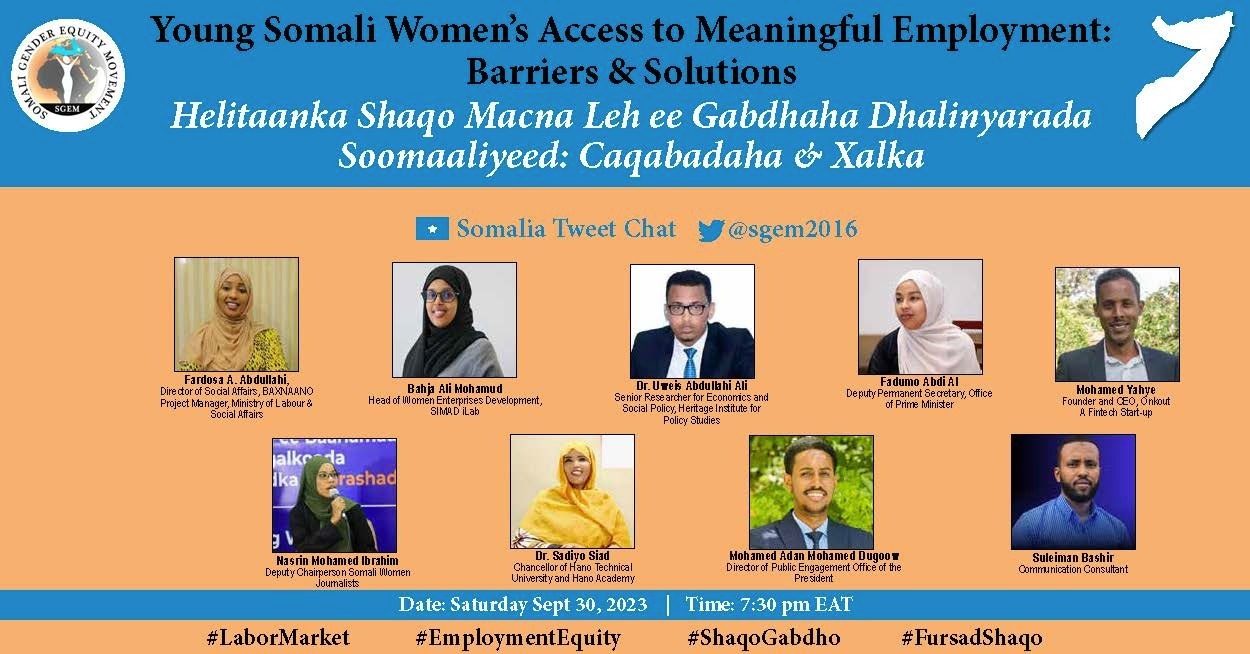
Somali Gender Equity Movement (SGEM) held its  Somalia Tweet Chat on a topic relating to the pervasive unemployment issue facing young women in Somalia entitled ‘Young Somali Women’s Access to Meaningful Employment: Barriers & Solutions’ which took place on September 30, 2023.
SGEM invited a diverse panel of practitioners, policy makers, and researchers working for the federal government, especially the Office of the President, Office of the Prime Minister and Ministry of Labour and Social Affairs. The panelists of the Somalia Tweet Chat included Fardosa A. Abdullahi, Director of Social Affairs BAXNAANO Project Manager at the Ministry of Labour and Social Affairs, Bahja Ali Mohamud, Head of Women Enterprises Development atSIMAD iLab, Dr. Uweis Abdullahi Ali, Senior Researcher for Economics and Social Policy at the Heritage Institute for Policy Studies (HIPS), Fadumo Abdi Ali, Deputy Permanent Secretary at the Office of Prime Minister, Mohamed Yahye, Founder and CEO of Onkout a Fintech Start-up, Nasrin Mohamed Ibrahim, Deputy Chairperson of Somali Women Journalists, Dr. Sadiyo Siad, Chancellor of Hano Technical University and Hano Academy, Mohamed Adan Mohamed Dugoow, Director of Public Engagement at the Office of the President, and Suleiman Bashir, Communication Consultant for government nonprofits and international organizations.
The panelists analyzed the topic from practitioner, policy, and research viewpoints. Tweet Chat questions asked included the status of the young women’s access to labor market in Somalia, such as cultural and class barriers facing young women to get meaningful employment, the laws and policies for employment equity in the country. Other key discussion questions included whether there is gender sensitive recruitment and retention policies in Somalia, and any policies protecting women from misconduct in the hiring processes and harassment at workplace. In addition, the panelists examined some innovative initiatives and programs that can facilitate meaningful employment opportunities for young women in Somalia.
The panel concluded with recommendations addressing these barriers and challenges for young women’s substantiative access to employment. Panelists recognized that enhancing young women’s access to meaningful employment requires comprehensive strategies that tackles cultural and class-related barriers. A multi-faceted approach should encompass initiatives in education, Technical, Vocational, Educational and Technical (TVET) skills, entrepreneurial skills, and digital literacy training, equal access to employment, and advocacy for economic empowerment programs.