
Contacts

92 Bowery St., NY 10013

thepascal@mail.com

+1 800 123 456 789

Category: Forum for Solutions

image
Forum for Solutions

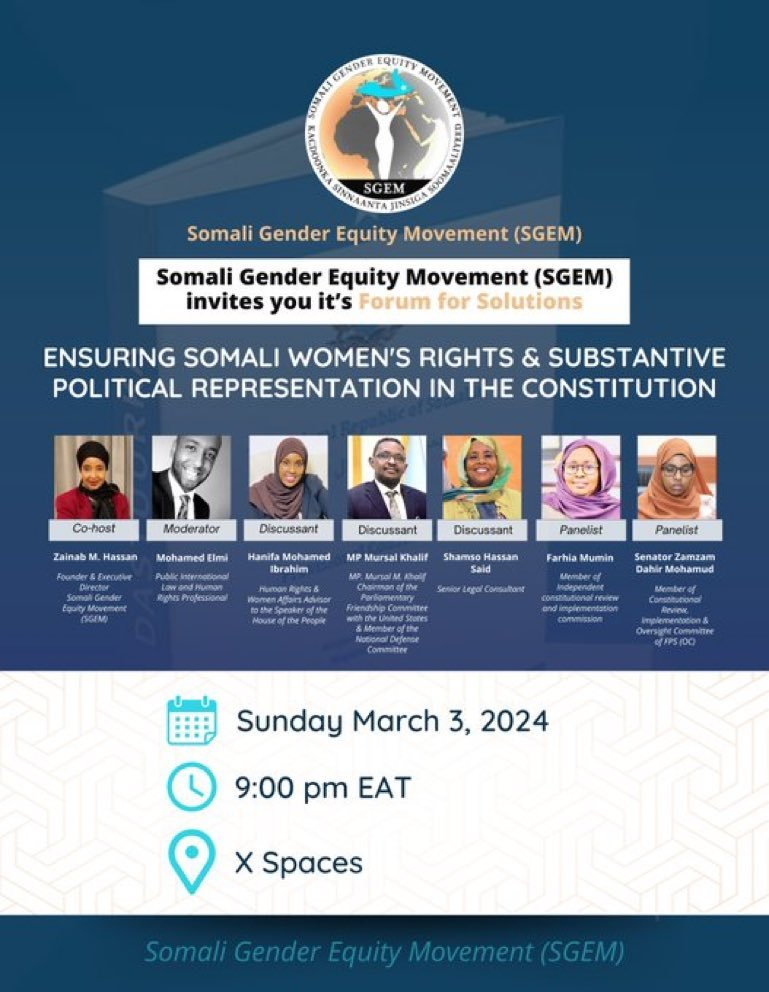
Ensuring Somali Women’s Rights & Substantive Political Representation in the Constitution
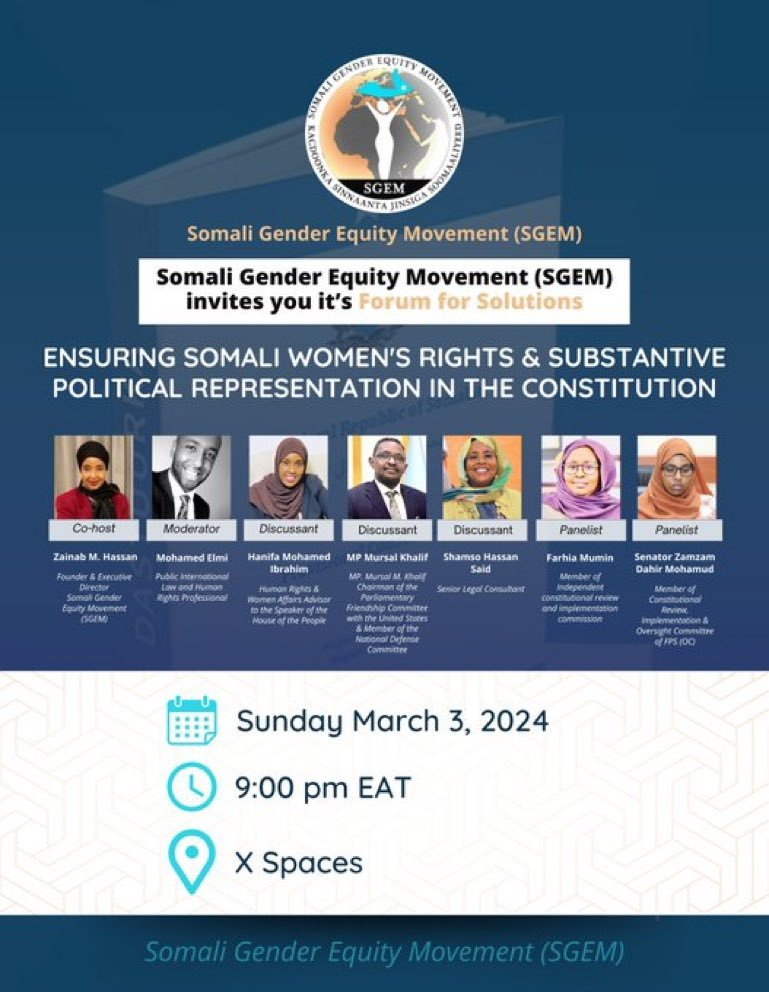
The federal institutions mandated by the constitution to draft and review the Provisional Constitution, namely the Constitutional Review, Implementation and Oversight Committee of the Federal Parliament of Somalia (OC) and the Independent Constitutional Review and Implementation Commission (ICRIC), began the review process of the first four chapters of the Provisional Constitution. The OC focuses on revising and amending the constitution, while the ICRIC handles the technical aspects. Against this backdrop, the Somali Gender Equity Movement (SGEM), in collaboration with women parliamentarians from both houses and civil society women, started advocating the amendment of Article 3, Paragraph 5 of Chapter One on the Basic Principles to clearly state: “Women shall hold a minimum of thirty percent (30%) of all positions across all three branches of government and independent commissions at Federal, Federal Member States, and local government levels, including elected and appointed positions” in the Provisional Constitution.

SGEM held its Forum for Solutions on this topic, entitled Ensuring Somali Women’s Rights & Substantive Political Representation in the Constitution, on March 3, 2024. SGEM invited esteemed panelists and discussants, including members directly involved in the Constitution review process and legal experts. These panelists and discussants were:

  • Senator Zamzam Dahir Mohamud, Member of the Constitutional Review, Implementation and Oversight Committee of the Federal Parliament of Somalia (OC)
  • MP Mursal M. Khalif, Chairman of the Parliamentary Friendship Committee with the United States and Member of the National Defense Committee
  • Farhia Mumin, Member of the Independent Constitutional Review and Implementation Commission
  • Hanifa Mohamed Ibrahim, Human Rights and Women Affairs Advisor to the Speaker of the House of the People, former Minister of Women and Human Rights Development, and former member of the 10th Parliament
  • Shamsa Hassan Said, Senior Legal Consultant

The forum was moderated by Mohamed Elmi, a Public International Law and Human Rights Professional, and co-hosted by Zainab M. Hassan, Founder & Executive Director of SGEM.

The panel discussed the mandate and role of their respective institutions in the ongoing constitutional review process, the basic rights of women citizenship, women’s substantive political representation, and the main challenges that have been impeding the formal inclusion of the women’s quota in the constitution. Additionally, the discussion highlighted the importance of building alliances and ensuring more male parliamentarians support women’s rights and the formal women’s quota in the constitution.

Panelists addressed whether the inclusion of the minimum 30% women’s quota in the constitution requires complementary laws, policies, or reforms to dismantle broader structural inequalities that impede women’s meaningful political participation in Somalia. They discussed how this can be enforced and implemented at the federal, member states, and local government levels. Conversely, they also explored alternatives to ensure women’s political representation if the quota is not formally included in the constitution.

The panelists highlighted the next steps once the ongoing constitutional review process is completed, and participated in a question and answer session with participants.

Panelists and discussants concluded with the importance to effect meaningful change by tailoring policies and initiatives according to the specific needs and contexts of communities. This involves identifying leaders within these communities who can effectively drive change. Establishing mentorship programs, starting from schools and extending to universities and beyond, which can help nurture a pipeline of qualified women professionals and leaders. Women who are already in leadership roles as valuable mentors and role models for girls in educational institutions, motivating them to engage politically. Panelists and discussants recognize implementing such initiatives requires collaboration between various stakeholders, including independent organizations, civil society groups, and government agencies. These partnerships should be driven by a shared interest in promoting gender equity and empowerment.
Forum for Solutions

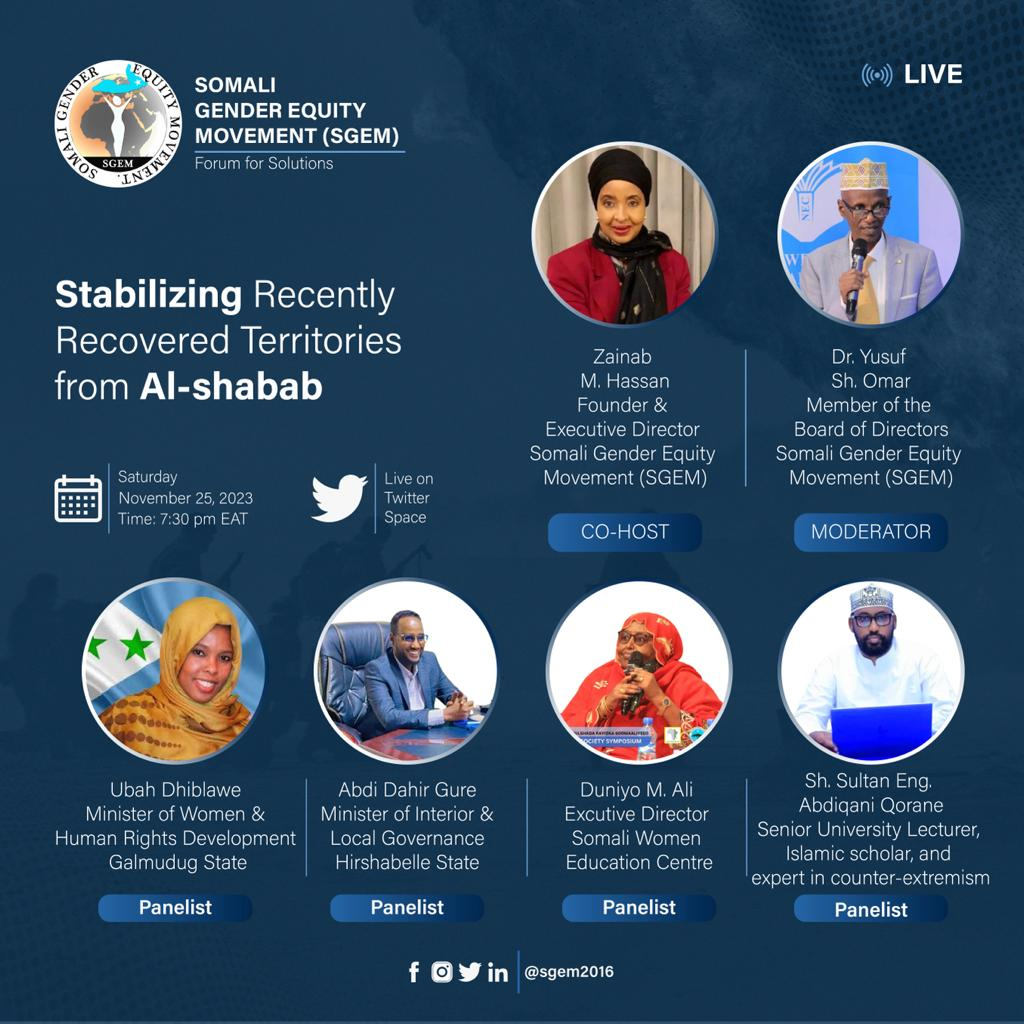
Stabilizing Recently Recovered Territories from al-Shabaab

The Federal Government of Somalia (FGS) has been involved in an offense against al-Shabaab since August 2022. The offensive war against al-Shabaab started organically by community militias known as Ma’awisley who were fed up with al-Shabaab’s extorsion, terror attacks, killings and forcibly recruiting children and youth in their war. This is the first time that the Somali National Army (SNA), and local communities like Ma’awisley are fighting against al-Shabaab collectively coupled with United States and Turkey aerial drones.

SGEM has organized its Forum for Solutions on this topic, entitled ‘Stabilizing Recently Recovered Territories from al-Shabaab’ which was held on November 25, 2023. The panelists included regional leaders, religious scholar/traditional elder and topic experts including Abdi Dahir Gure, Minister of Interior and Local Governance for Hirshabelle Federal Member State; Ubah Dhiblawe, Minister of Women and Human Rights Development for Galmudug Federal Member State; Sultan Abdisalam Qorane, Senior University Lecturer, Islamic Scholar and Expert on Counter Terrorism; and Duniyo Mohamed Ali, Executive Director of Somali Women Education Centre.

The forum provided an informative discussion on the overall status of the offensive against al-Shabaab in the national and regional levels, its challenges, and the ongoing stabilizing efforts in the Federal Member States (FMSs). Leaders from theFMSs identified the role that their ministries are playing, the challenges that  women and their families are facing, and the role women are playing in the overall efforts. Other panelists further highlighted the role that the civil society including women organizations and groups, traditional elder and religious leaders are playing in the offensive, and stabilizing the territories that are recently liberated from al-Shabaab.

Somali women play a significant role in supporting the offensive war against al-Shabaab. Women are members of the SNA and Ma’awisley militias, but most of their support comes as humanitarian, taking care of the injured, preparing and providing ration for the armed forces, fundraising from diaspora communities, providing encouragement and moral support, and conducting civic education for the citizens in the newly liberated areas.

Some of the key accomplishments highlighted include the liberation of 52,000 KM2 area from al-Shabaab including 126 districts, and villages in which 57 villages were operation centers created by al-Shabaab, and are currently in the hands of the government. Despite the significant progress make in the offensive against al-Shabaab, there are also some challenges including Somali National Army (SNA) stopping the fighting and restarting which gives al-Shabaab an opportunity to regroup and plan attacks against the SNA and the communities that are part of the offensive. In addition, the liberated areas face many challenges including lack of education and health care centers since some of these areas were under al-Shabaab control for the past 15 years. Lack of stabilization and development efforts for the newly liberated areas is another challenge. Women also face some specific challenges as they are excluded from the planning and stabilization efforts. This causes their views and specific needs are missing from the planning process, and as a result from the implementation of projects and services.

Some of the key recommendations are:

  • Enhanced collaboration and coordination between the FGS and the FMSs on all the aspects of the fight with al-Shabaab.
  • The FGS and the SNA to continue the offensive without any breaks or stoppage.
  • To increase the engagement of local community members in the areas to be liberated.
  • The business community, Somali diaspora, and the public in Somalia should be encouraged to provide more support for the offensive, and the stabilization and development efforts of the liberated areas, particularly of rebuilding and rehabilitating schools, hospitals, and Maternal and Child Health (MCH) centers.
  • The government and civil society should provide more civic education and engagement for the residents of the newly liberated areas, and
  • The Federal Government of Somalia in collaboration with the Federal Member States should build local governance for the newly liberated districts.
The-Gendered-Impact-of-Climate-Change
Forum for Solutions

The Gendered Impact of Climate Change on the Lives of Somali Women

Somalia and the Horn of Africa in general have been severely impacted by climate change. Somalia has been dealing with climate shocks including prolonged droughts, flooding during the rainy season, and locusts. These climate crises make women more vulnerable and the most impacted. The Federal Government of Somalia established the Ministry of Environment and Climate Change for the first in the history of the country.

SGEM’s Forum for Solutions explored The Gendered impact of Climate Change on the Lives of Somali Women on September 17, 2022, through its Forum for Solutions. Distinguished panelists including policymakers, practitioners, researchers, and longtime environmental activists discussed this topic thoroughly. The panelists included Adam Aw Hirsi, State Minister of the Ministry of Environment and Climate Change, Fatima Jama Jibrell, retired Environmental Activist, Kassim GabowDuale, Country Representative for the Nordic International Support Foundation, and Abdikani R. Barrow, Senior Environmental Advisor to the Ministry of Environment and Climate Change.

The Panelists reflected on the overall environmental shocks and the impact of these climate changes in Somalia, the existing and planned institutional plans and policies of the new Ministry of Environment and Climate Change to curb the environmental degradation in Somalia. They further explored the different consequences climate change has on different segments of the society, its impact on the lives of Somali women, and the ramifications of climate change on Somali women’s economic development and vulnerable groups in particular. The panel further discussed some of the ongoing governmental and not-for-profit organization initiatives and programs on combating the impact of climate change on the environment and the livelihood of women and the Somali people in Somalia. The panelists made recommendations on combating climate change and environmental degradation in Somalia. The forum concluded with questions, answers, and comments from participants.

Somalia-Indirect-Elections-Legitimacy-and-Inclusivity-2022-02-26
Forum for Solutions

Somalia’s Indirect Elections: Legitimacy and Inclusivity

SOMGEM held a forum titled Somalia’s Indirect Elections: Legitimacy and Inclusivity through its Forum for Solutions on February 26, 2022, as a follow-up to Somalia’s indirect election which after considerable delay was marred with conflict towards women parliamentary candidates, violations of the agreed-upon electoral process, and corruption. The Panelists included some of the Somali leaders, legal and topic experts, and researchers including Hanifa M. Ibrahim, Minister of Women and Human Rights Development, Dr. Afyare Elmi, Executive Director of Heritage Institute for Policy Studies, Dr. Ahmed Ali M. Khayre, Legal Consultant, Senior Lecturer and Researcher, and Dr. Shukria Dini, Executive Director of Somali Women Studies Centre, and a member of Goodwill Ambassadors.

In this forum, the panelists assessed from a legal, practical perspective the state of the 2021-2022 indirect elections, the overall agreements of the National Consultative Council for the electoral process including the 30 percent quota for women, and to what extent these agreements were implemented. The main challenges and concerns regarding the 2021 indirect elections were discussed. Panelists further compared the 2016 and 2021 indirect elections concluding that the 2016 indirect election was more legitimate and inclusive.

Panelists also highlighted the factors that made it difficult to achieve the minimum 30 percent quota, the procedural irregularities of the electoral process, and some of the ramifications regarding legitimacy and credibility. The panel concluded with recommendations for this upcoming parliament and the next electoral cycle and government.

FC4IrH3XEAIN11Q
Forum for Solutions

Enhancing Broader Human Security & Accountable Institutions

The sixth and last forum of 2021, The sixth and last forum of 2021, Enhancing Broader Human Security & Accountable Institutions focused on generating ideas on how to enhance security institutions’ accountability and broaden our understanding of security to encompass broader human security. This session was held on October 30, 2021. The Forum described the state of accountability for Somalia’s security institutions and assessed how a broader Human Security agenda be included in the overall security institution of Somalia in the context that human security is human rights that refers to the security of people and communities as opposed to the security of the state. It recognizes that there are several dimensions related to feeling safe, such as freedom from fear, freedom from poverty, and freedom from indignity.

Panelists discussed ways to generate ideas on how to enhance security institutions’ accountability and broaden our understanding of security to encompass broader human security. Panelists also highlighted ways to improve security institutions’ accountability, how to promote broader human security, and some mechanisms to ensure that Security Institutions are held accountable in the case of unintended harmful practices by both the Somali security sector and AMISOM. The Panelists concluded with recommendations followed by questions, answers, and suggestions from the participants.

E9o8VNnX0AE6NYw
Forum for Solutions

Ensuring Somali Women’s Substantive Political Participation & Representation in 2021 & Beyond

SOMGEM’s forum titled Ensuring Somali Women’s Substantive Political Participation & Representation in 2021 and Beyond was held on August 28, 2021. It focused on women’s fair access to elected positions. Panelists addressed the patriarchal challenges that permeate the Somali context and how these can be minimized during the upcoming electoral process to ensure women MPs are elected. They further discussed the main challenges women candidates have been facing and could face during the electoral process.

The Panelists also highlighted the potential impact of the recent decision of the National Consultative Council (NCC) on the indirect elections that gives a lot of power to the Federal Member State leaders and state electoral bodies on the selection, and representation of clan communities for the House of the People, specifically women looking from a human rights perspective. It also discussed why women’s representation in the Somali parliament and other important positions matter from a religious perspective.

Ensuring Somali women’s quota in the current elections, and how can women persevere to gain access to political representation at all levels of government were underlined. In this session, Panelists concluded with mechanisms and strategies to minimize the negative discriminatory impact of patriarchy in Somali society and on women running for elections. Lastly, some of the participants asked questions and made suggestions and recommendations.

image
Forum for Solutions

Complexities around Ratifying Somalia’s Constitution: Cutting through the Rhetoric

The fourth forum entitled Complexities around Ratifying Somalia’s Constitution: Cutting through the Rhetoric was held on June 27,  2021. Panelists were asked to discuss and reflect on issues and challenges surrounding the Somalia Provisional Constitution, and provide their perspectives on why it has yet to be ratified.

The Panelists further analyzed the impediments to a clear and inclusive constitutional review process given there is a parliamentary committee, National Independent Constitution Review Commission, Federal Ministry of Constitution, and state-level ministries involved in the review process as well as some of the social and political barriers to the completion of the Somali Constitution.  Panelists also addressed ways to get a Somali-owned constitutional process, whether it is realistic and achievable to complete the constitutional review process by June 2022, and how inclusive constitutional ratification be carried out in the absence of Somaliland, even if all the contentious issues are agreed upon. The Forum concluded with the way forward for an inclusive, transparent, and gender-sensitive constitutional review process, followed by comments, and questions from participants.

image
Forum for Solutions

Substantive Reconciliation in Somalia

Given the multiple reconciliation efforts in Somalia in the past 30 years with little impact, SGEM convened this forum to be an in-depth discussion on substantive reconciliation. The forum titled Substantive Reconciliation in Somalia was held on April 10, 2021, and it was one of the timely topics for SGEM’s Forum for Solutions. The panelists for this forum included Abukar Arman, Somali Writer and Former Diplomat, Dr. Habon Abdulle, Executive Director of Ayada Leads, Suldan Abdisalam Ahmed, Peace and Conflict Studies Scholar & Traditional Elder, and Moderator and Discussant, Fowsia Abdulkadir, Chairwoman & Founding Member, Somali Gender Equity Movement (SGEM).

The  Panelists discussed the impediments to a substantive reconciliation in Somalia given there are multiple dimensions to reconciliation whether political or social, what kind is needed in Somalia, and which one should be tackled first. The Panelists also explored the barriers to substantive reconciliation and the missing link to reconciliation in Somalia. The discussions also focused on the required sequencing of reconciliation efforts, and the actors that should lead these reconciliation efforts that Somalia needs.

The role religious leaders, women, and young people can play in substantive reconciliation, and ways in which we can get Somali-owned substantive reconciliation were highlighted. The Panelists made their concluding remarks on the way forward in realizing comprehensive, and inclusive reconciliation in Somalia. The forum closed with participants asking relevant questions to the panelists to address, and adding their own reflections on the topic.

E35RhjmXEAQUebb
Forum for SolutionsSomali Tweet chat

Substantive Reconciliation in Somalia

Tellus mauris a diam maecenas sed enim ut sem. Viverra accumsan in nisl nisi scelerisque eu ultrices vitae. Pellentesque eu tincidunt tortor aliquam.

The-Gendered-Impact-of-Climate-Change
Forum for Solutions

Maintaining Peace & Stability in Somalia while Resolving Electoral Issues

Diam maecenas sed enim ut sem. Aliquet enim tortor at auctor urna. Quam pellentesque nec nam aliquam sem et tortor consequat. Facilisi morbi tempus iaculis urna id volutpat lacus laoreet non.