Contacts

92 Bowery St., NY 10013

thepascal@mail.com

+1 800 123 456 789

YCDD-Cover-copy
Report

Youth Capability and Development Domain Report

This study is conducted for the Youth and Capability Development domain in Mogadishu. The report highlights the methodology used for this research, stakeholders involved, the ways in which urban politics, policy interventions, and city systems relate to, are shaped by, and influence young people’s lives. It also explores the challenges, opportunities, and aspirations that young people experience and hold alongside the programs and historical trends that shape their lives and future.

Study findings reveal a range of critical challenges that face young people in Mogadishu, increasing their vulnerability and limiting their future horizons. Chronic violence, inequity, and little recourse to access justice have characterized the environment in which Mogadishu’s youth have grown up. Today in Somalia, entire generations have lived in a context of chronic violence, and they have existed in survival mode for decades.[1] This exposure to violence has had a long-lasting effect on young people as they grow up, but this has not been well accounted for historically in most youth initiatives. High levels of trauma act as a barrier to the creation of individual, collective and community resilience and empowerment. This, in turn, impacts the ability of young people to engage positively in political, economic, and social arenas.

These vulnerabilities are exacerbated by a range of city system failures. Most prominently here, the collapse of the Somali state in 1991 led to the breakdown of critical health and education services as well as the social fabric that play a central role in young people’s futures. The public provision of both sectors remains limited, and the costs of private provision are often unattainable for the majority of the population.

The gendered nature of these challenges is also revealed through this research. The challenges facing young women and girls are particularly acute. These start early in the life-course through the structural and cultural norms that underpin this gender inequity, which is evident in the higher rates of school dropout and unemployment for young women. They also face regular sexual violence and harassment.

Download

Security-Development-Nexus
Somali Tweet chat

Security Development Nexus: Prospective for Stability, Peace & Sustainable Development

Somalia is currently engaged in an offensive war with al-Shabaab. Somalia’s president, Hassan Sheikh Mohamud (HSM) elected in 2022, vowed to defeat the al-Shabab terrorist group after his election. Under the Administration of president HSM, the Federal Government of Somalia’s (FGS) security sector and community members known as Ma’awisley who uprose and took arms against al-Shabaab are involved in the offensive in some of the Federal Member States (FMSs supported by drone strikes by the United States. A significant number of towns and villages some of which were strategic towns for al-Shabaab were liberated, and are still ongoing. Considering these gains, SGEM conducted a Somalia Tweet Chat forum on Security Development Nexus: Prospective for Stability, Peace & Sustainable Development on November 27, 2022.

SGEM invited diverse Panelists to assess the situation from different angles. Panelists included Faisal Roble, Principal City Planner and CEO for Justice and Equity Los Angeles city, Hodan Hassan, Executive Director of Kulan Consulting, Osman Moallim, Chairman of Somali Non-State Actors (SONSA), Ismail Osman, Former Deputy Director of National Intelligence Security Agency (NISA), Subeida Mukhtar, Engagement Lead for Somali Dialogue Platform, and Ilham Gassar, Political and Reconciliation Specialist.

The panelists shared their views on what this liberation war means for Somalia and the Somali people, the role that the African Union Transition Mission in Somalia (ATIMS) is playing in this new offensive, and whether they are fulfilling their mandate. They further discussed the role of the Federal Member States (FMSs) in the current offensive, and the type of support they need to stabilize communities. Panelists further analyzed who is responsible to make sure security is maintained in the newly liberated areas, and how can we make sure the government controls the areas going forward. The key elements needed to form functional local governments in the newly liberated areas were elaborated. They also highlighted the stabilization and development efforts that are needed in the liberated areas and the soon-to-be liberated areas, and ways both the Somali government, and development actors can connect with local communities to understand their current needs. Panelists also discussed some of the local historical grievances emerging between groups as they are liberated, and what can be done to support reconciliation and healing between the various communities. This Somalia Tweet Chat session concluded with some recommendations to the Somali government to make the current offensive to be successful, and key strategies and viable plans that the government should be considering.

The-Gendered-Impact-of-Climate-Change
Forum for Solutions

The Gendered Impact of Climate Change on the Lives of Somali Women

Somalia and the Horn of Africa in general have been severely impacted by climate change. Somalia has been dealing with climate shocks including prolonged droughts, flooding during the rainy season, and locusts. These climate crises make women more vulnerable and the most impacted. The Federal Government of Somalia established the Ministry of Environment and Climate Change for the first in the history of the country.

SGEM’s Forum for Solutions explored The Gendered impact of Climate Change on the Lives of Somali Women on September 17, 2022, through its Forum for Solutions. Distinguished panelists including policymakers, practitioners, researchers, and longtime environmental activists discussed this topic thoroughly. The panelists included Adam Aw Hirsi, State Minister of the Ministry of Environment and Climate Change, Fatima Jama Jibrell, retired Environmental Activist, Kassim GabowDuale, Country Representative for the Nordic International Support Foundation, and Abdikani R. Barrow, Senior Environmental Advisor to the Ministry of Environment and Climate Change.

The Panelists reflected on the overall environmental shocks and the impact of these climate changes in Somalia, the existing and planned institutional plans and policies of the new Ministry of Environment and Climate Change to curb the environmental degradation in Somalia. They further explored the different consequences climate change has on different segments of the society, its impact on the lives of Somali women, and the ramifications of climate change on Somali women’s economic development and vulnerable groups in particular. The panel further discussed some of the ongoing governmental and not-for-profit organization initiatives and programs on combating the impact of climate change on the environment and the livelihood of women and the Somali people in Somalia. The panelists made recommendations on combating climate change and environmental degradation in Somalia. The forum concluded with questions, answers, and comments from participants.

Uncategorized

Collective & Communal Healing Centered Reconciliation

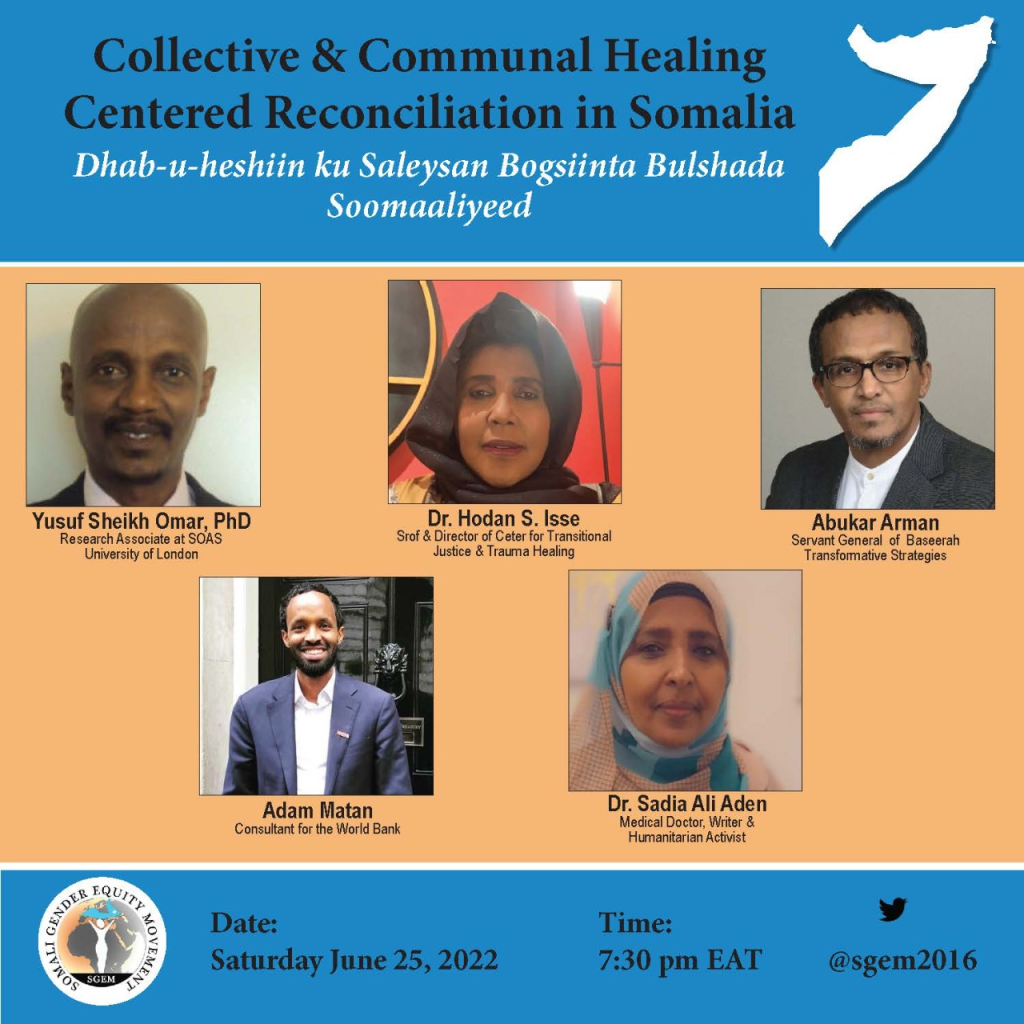
As part of its peacebuilding, reconciliation, and conflict resolution program, SGEM held Somalia Tweet Chat on Collective & Communal Healing Centered Reconciliation in Somalia with a panel of experts including, Dr. Yusuf Sheikh Omar, Ph.D., Research Associate at SOAS University of London, Dr. Hodan S. Isse, Prof & Director of Center for Transitional Justice & Trauma Healing, Abukar Arman, Servant General of Baseerah Transformative Strategies, Dr. Sadia Ali Aden Medical Doctor, Writer & Humanitarian Activist, and Adam Matan, Consultant for the World Bank.

The Panelists shared the key issues surrounding reconciliation that need communal and collective healing in Somalia today, some indigenous and religious Somali collective healing practices, and the role Somali women can play. They also addressed the vision for the new administration “A Somalia at peace with itself and at peace with the world,” and how collective trauma healing and reconciliation can support the realization of this vision. Further discussions were involved in where communal and collective healing can start, whether genuine reconciliation and communal healing can take place without addressing the issues around commonly owned resources, and the first steps needed to be taken. The panelists concluded with some key recommendations in order to achieve collective and communal healing-centered reconciliation.

#HeshiisDhabAh                      #SherosForPeace                    #CollectiveHealing                     #ParadigmShift

SGEM-Annual-Report-1
Report

SGEM Annual Report 2021

SGEM Annual Report – 2021 provides a brief background, some of the activities that SGEM conducted in 2021, and some of the future plans.

Donlwoad here

SWV-1
Publication

War Murtiyeed Codka Haweenka Soomaaliyeed oo ku aadan Qoondada Dumarka

Anagoo ah Kacdoonka Somali Gender Equity Movement oo loo soo gaabiyo SGEM, Guddigiisa, xubnahiisa oo ku dhaw ilaa 8,000 oo haween ah oo ay ka mid yihiin hogaamiyayaasha haweenka Soomaaliyeed iyo haweenka bulshada qaybaheeda kala duwan:

• Waxaan aad uga xunnahay in qoondada haweenka aan mar kale la buuxin bartilmaameedka ugu yaraan 30%, oo xitaa ay ka hooseyso heerkii 2016 ee Haweenka Golaha Shacabka oo ahaa 24% haddana mareyso 20%.

• Hoos u dhaca matalaadda haweenku waa nasiib darro. Waxaa iyaduna aad u foolxun in haweenka Soomaaliyeed loo isticmaalay “Malxiis” ayadoo la og yahay in aan kursiga la siineyn, si ragga kuraasta loo xiray looga dhimo lacagta laga rabo diiwaangelinta
doorashada.

• Fashilka qoondada haweenka waxaa mas’uul ka ah madaxda Soomaalida oo ay ugu horreeyaan Ra’iisul Wasaaraha, Madaxweynayaasha Dowlad Goboleedyada xubnaha ka ah Dowladda Federaalka iyo Guddiyada Doorashada.

• Waxaan ku talineynaa in Gudiga Doorashada Heer Federaal ay laalaan/joojiyaan kuraasta beelaha leh 3 kuris ama ka badan oo aysan kuraastooda ku jirin haween maadaama ay ku xadgudbeen Heshiikii 17 ka Sebtember 2020 iyo habraacyadii iyo baaqyadii ka dambeeyey ee xaqiinjinta qoondada haweenka.

Somalia-Indirect-Elections-Legitimacy-and-Inclusivity-2022-02-26
Forum for Solutions

Somalia’s Indirect Elections: Legitimacy and Inclusivity

SOMGEM held a forum titled Somalia’s Indirect Elections: Legitimacy and Inclusivity through its Forum for Solutions on February 26, 2022, as a follow-up to Somalia’s indirect election which after considerable delay was marred with conflict towards women parliamentary candidates, violations of the agreed-upon electoral process, and corruption. The Panelists included some of the Somali leaders, legal and topic experts, and researchers including Hanifa M. Ibrahim, Minister of Women and Human Rights Development, Dr. Afyare Elmi, Executive Director of Heritage Institute for Policy Studies, Dr. Ahmed Ali M. Khayre, Legal Consultant, Senior Lecturer and Researcher, and Dr. Shukria Dini, Executive Director of Somali Women Studies Centre, and a member of Goodwill Ambassadors.

In this forum, the panelists assessed from a legal, practical perspective the state of the 2021-2022 indirect elections, the overall agreements of the National Consultative Council for the electoral process including the 30 percent quota for women, and to what extent these agreements were implemented. The main challenges and concerns regarding the 2021 indirect elections were discussed. Panelists further compared the 2016 and 2021 indirect elections concluding that the 2016 indirect election was more legitimate and inclusive.

Panelists also highlighted the factors that made it difficult to achieve the minimum 30 percent quota, the procedural irregularities of the electoral process, and some of the ramifications regarding legitimacy and credibility. The panel concluded with recommendations for this upcoming parliament and the next electoral cycle and government.

FC4IrH3XEAIN11Q
Forum for Solutions

Enhancing Broader Human Security & Accountable Institutions

The sixth and last forum of 2021, The sixth and last forum of 2021, Enhancing Broader Human Security & Accountable Institutions focused on generating ideas on how to enhance security institutions’ accountability and broaden our understanding of security to encompass broader human security. This session was held on October 30, 2021. The Forum described the state of accountability for Somalia’s security institutions and assessed how a broader Human Security agenda be included in the overall security institution of Somalia in the context that human security is human rights that refers to the security of people and communities as opposed to the security of the state. It recognizes that there are several dimensions related to feeling safe, such as freedom from fear, freedom from poverty, and freedom from indignity.

Panelists discussed ways to generate ideas on how to enhance security institutions’ accountability and broaden our understanding of security to encompass broader human security. Panelists also highlighted ways to improve security institutions’ accountability, how to promote broader human security, and some mechanisms to ensure that Security Institutions are held accountable in the case of unintended harmful practices by both the Somali security sector and AMISOM. The Panelists concluded with recommendations followed by questions, answers, and suggestions from the participants.

WhatsApp-Image-2022-02-13-at-9.35.57-AM
Somali Tweet chat

The Complexities Surrounding Somalia’s Security Architecture

This Somalia Tweet Chat was a timely Tweet Chat discussion for a time that a lot of controversies were surrounding the security sector. the state of accountability for Somalia’s security institutions was described, as well as the key impediments to Somalia’s National Security Architecture. It further highlighted the major security gaps in Somalia’s Transition Plan, and ways a broader Human Security agenda can be included in the Transitional plan.

How the protection of citizens, particularly women and children can be ensured during the current political crisis and transition, and some mechanisms to ensure that Security Institutions are held accountable in the tragic case of the missing intelligence officer, Ikraan Tahliil were laid out. Whether the Somali security institutions are ready to take over the security responsibilities once the African Union’s peacekeeping mission, AMISOM exits in 2023 were analyzed. This tweet chat session concluded with recommendations on how to strengthen the performance and accountability of the security sector.

#AmniSugan #Accountability #Justice #HumanSecurity 

E9o8VNnX0AE6NYw
Forum for Solutions

Ensuring Somali Women’s Substantive Political Participation & Representation in 2021 & Beyond

SOMGEM’s forum titled Ensuring Somali Women’s Substantive Political Participation & Representation in 2021 and Beyond was held on August 28, 2021. It focused on women’s fair access to elected positions. Panelists addressed the patriarchal challenges that permeate the Somali context and how these can be minimized during the upcoming electoral process to ensure women MPs are elected. They further discussed the main challenges women candidates have been facing and could face during the electoral process.

The Panelists also highlighted the potential impact of the recent decision of the National Consultative Council (NCC) on the indirect elections that gives a lot of power to the Federal Member State leaders and state electoral bodies on the selection, and representation of clan communities for the House of the People, specifically women looking from a human rights perspective. It also discussed why women’s representation in the Somali parliament and other important positions matter from a religious perspective.

Ensuring Somali women’s quota in the current elections, and how can women persevere to gain access to political representation at all levels of government were underlined. In this session, Panelists concluded with mechanisms and strategies to minimize the negative discriminatory impact of patriarchy in Somali society and on women running for elections. Lastly, some of the participants asked questions and made suggestions and recommendations.